New Dosage for an Old Drug
After seven years of research involving four institutions, Le Bonheur Children’s Hospital recently published research in the Journal of Pediatric Pharmacology and Therapeutics with new dosing guidelines for the use of clopidogrel for children younger than two years. The drug, commonly known as Plavix, was studied in 0 to 24-month-old patients in Le Bonheur’s Cardiovascular Intensive Care Unit (CVICU).
“Research on antiplatelet drugs like Plavix has become increasingly essential with new pediatric cardiology developments,” said Pediatric Cardiac Critical Care Intensivist Mario Briceno-Medina, MD. “CVICU patients now have less invasive heart surgery alternatives, such as inserted devices like stents and shunts, however, the presence of devices leads to increased risk of blood clotting around them.”
While past guidelines suggested a static dosage of Plavix for children younger than 24 months, this new research from Le Bonheur shows that patients may require a gradual, age-based escalation of clopidogrel dosing to be most effective.

Le Bonheur physicians and pharmacists worked together to develop new guidelines for patients in the Cardiovascular Intensive Care Unit (CVICU) on clopidogrel, commonly known as Plavix. From left to right, Cardiac Critical Care Intensivist Mario Briceno-Medina, MD, Pharmacist Carli Coalter, PharmD, and Pharmacist Mark Rayburn, PharmD, were part of the team that worked to find the most effective dosing scheme for this patient population.
In 2018, Le Bonheur’s CVICU staff first observed an increase in the prescription of Plavix, an antiplatelet medication used to prevent serious blood clots, heart attacks and strokes. The rise in Plavix usage led staff to reconsider the guidelines provided by the 2008 Platelet Inhibition in Children on cLOpidogrel trials (PICOLO).
Rather than a gradual dosage, the PICOLO trials recommended a sudden fivefold increase from the dosage in 0 to 24-month-old patients to patients 24 months and older. Immediately after patients reached 24 months, dosage jumped from 0.2mg/kg/day to 1mg/kg/day.
“Questions about the PICOLO trial dosage have been going on for a while, and we worked off what they did,” said Mark Rayburn, PharmD, a Le Bonheur pharmacist. “At Le Bonheur, we had enough patients to model out the dosage and follow them in-house for longer.”
Between 2018 and 2021, the Le Bonheur team conducted an initial retrospective cohort study and proposed a linearly increasing dosage scheme. They evaluated platelet inhibition in blood samples from 44 patients younger than 24 months.
The team’s research concluded that pediatric cardiac patients may require a gradual escalation of Plavix dosing, in contrast to the existing guidelines recommended by the PICOLO trial.
Le Bonheur’s new guidelines stayed within the range of the PICOLO trials but increased dosing gradually throughout 24 months. Dosage began at 0.2 mg/kg/day and reached as much as 1mg/kg/day, typically averaging an increase every three months. The guidelines were so successful at preventing clotting in patients that Rayburn initiated a formal research project. This research project involved collaboration between Le Bonheur pharmacists and physicians. Beyond Le Bonheur, the team members included participants from the University of Memphis, Children’s Hospital of Philadelphia and Children’s Health in Dallas.
“The collaborative aspect of the research was very important to me,” said Rayburn. “Pharmacists, by assessing the laboratories, help the physicians achieve their goal of helping the patients.”
In addition to Rayburn, collaboration at Le Bonheur involved two pharmacy residents, Katie DeAvilla and Carli Coalter, and Pediatric Cardiac Critical Care Intensivist Mario Briceno-Medina, MD.
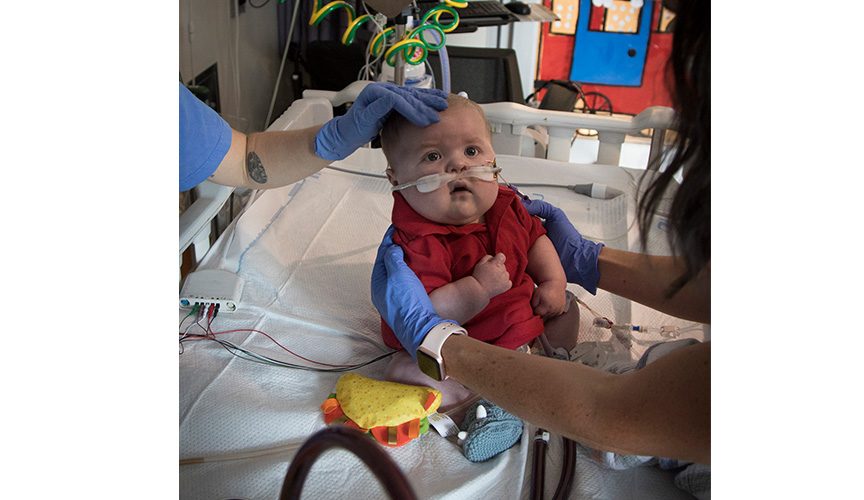
An increase in the use of devices for children with heart conditions means an increased risk of blood clotting. A team in Le Bonheur’s Cardiovascular Intensive Care Unit developed new guidelines for using the antiplatelet drug Plavix (clopidogrel) for these patients younger than 24 months.
“Although Plavix is an old medication, it will continue to be used quite a lot with all the changes happening in interventional cardiology,” said Briceno-Medina. “Having an algorithm where we are more comfortable achieving the goal while using a minimal amount of drug makes a huge difference in clinical practice.”
Briceno-Medica and Rayburn hope to see their publication become a dosing guideline in the Lexicomp, a medical drug database, to reach doctors around the world and support more CVICU patients vulnerable to clotting.
“These ideas are born as we try to figure out problems we may encounter every day. It takes someone to pay a little more attention, identify the issue and raise the question, ‘what can we do about this,’” said Briceno-Medina.
Help us provide the best care for kids.
Le Bonheur Children's Hospital depends on the generosity of friends like you to help us serve 250,000 children each year, regardless of their family’s ability to pay. Every gift helps us improve the lives of children.
Donate Now