TSC, Early Vocal Development and Autism
Tuberous sclerosis complex (TSC) is a genetic condition often associated with epilepsy and language delays, yet language impairments are frequently not identified until children are around 7 years old. Le Bonheur Neurodevelopmental Specialist Tanjala Gipson, MD, is first author of “Early Vocal Development in Tuberous Sclerosis Complex Predicts Language but Not Autism Outcomes” published in Pediatric Neurology, which examined early vocal development in infants with TSC as a predictor of later speech and language outcomes.
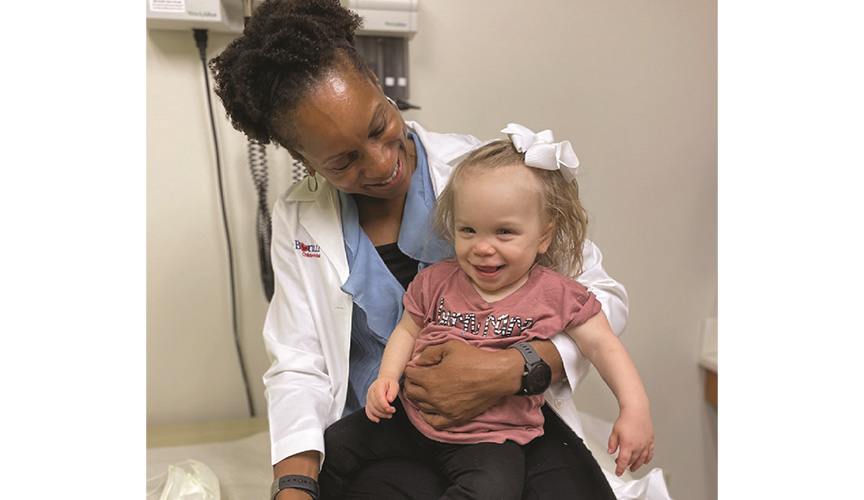
The study built on previous research and data shared by the Tuberous Sclerosis Complex Autism Center (TACERN) and is part of Gipson’s K23 grant from the National Institutes of Health. Using recordings from 108 12-month-old infants with TSC, Gipson measured vocalizations and canonical babbling — the speech sounds that form the foundation of language.
Infants with TSC showed lower canonical babbling ratios (CBR) and reduced vocalizations compared to typically developing infants. While reduced vocalizations did not predict later outcomes, lower CBR significantly predicted receptive and expressive language delays at 24 months. CBR was not associated with autism spectrum disorder.
“For families and clinicians, this research is a helpful and low-tech tool and holds promise as an inexpensive, noninvasive way to identify children with TSC who may benefit from earlier speech and language support,” said Gipson. The research concluded that delayed canonical babbling may serve as an early marker of future language impairment, enabling earlier intervention and support for children with TSC.
Help us provide the best care for kids.
Le Bonheur Children's Hospital depends on the generosity of friends like you to help us serve 250,000 children each year, regardless of their family’s ability to pay. Every gift helps us improve the lives of children.
Donate Now